
我们觉得普尚吉的《器官之歌》(Organology and Sensology in Yogashastra)算是他著作里最简单的一本了。
错!!!
它背后的原理,可以在普尚吉的另一套系列著作中找到本源思想,请看摘自《帕坦伽利瑜伽经研究/三摩地篇》(原著第 120 页)里面的这段话,即可对《器官之歌》获得更深的理解。
It should be understood that as air cannot be seen directly, it can however be inferred from its functions, such as flow, blowing, movement, breeze, etc. 应该理解的是: 空气不能被直接看到,但从它的功能,却可以被推断出来,比如它的风起云涌,它的清风拂面。
Similarly, Prakrti, in its intrinsic form/nature, cannot be directly perceived but can be inferred from its functions. Prakrti manifests itself in the physical objects in the form of Sabdavisaya, Sparsavisaya, Rupavisaya, Rasavisaya and Gandhavisaya, as the phenomenal visible universe. Or this is the form of the physical creation.“原质”本身也是同理,它无法被直接知觉其本质的形式/属性,却能从它的功能被推断出来;“原质”会以看得见、摸得着的宇宙现象,即听觉的形式、嗅觉的形式、视觉的形式、味觉的形式、触觉的形式而在实体中显现;这或者也是创世的形式。
On the metaphysical plane, Prakrti manifests itself as elemental matter. This is composed of the Panchamahabhutas. Earlier to this phase, there is the plane of infra-matter. This is composed of the Tanmatras. Earlier to this, too, there is the supra-matter plane. It is composed of the Ahamkara and the Mahat. The terminal or the original plane is the phase of primeval matter.
而在形而上的层面,“原质”本身就是元素性的物质,是由五大元素构成的。比这个更早的阶段,则是微物质层面,由更加微妙的元素构成;比微妙元素更早的阶段,则是“小我意识”和“大我意识”;而到了终极和源头层面,则是原初的物质。
*《瑜伽经》里都有阐述。
以下為課程連結
器官之歌 (視頻版) : https://yogalates.cc/courses/qgzg/
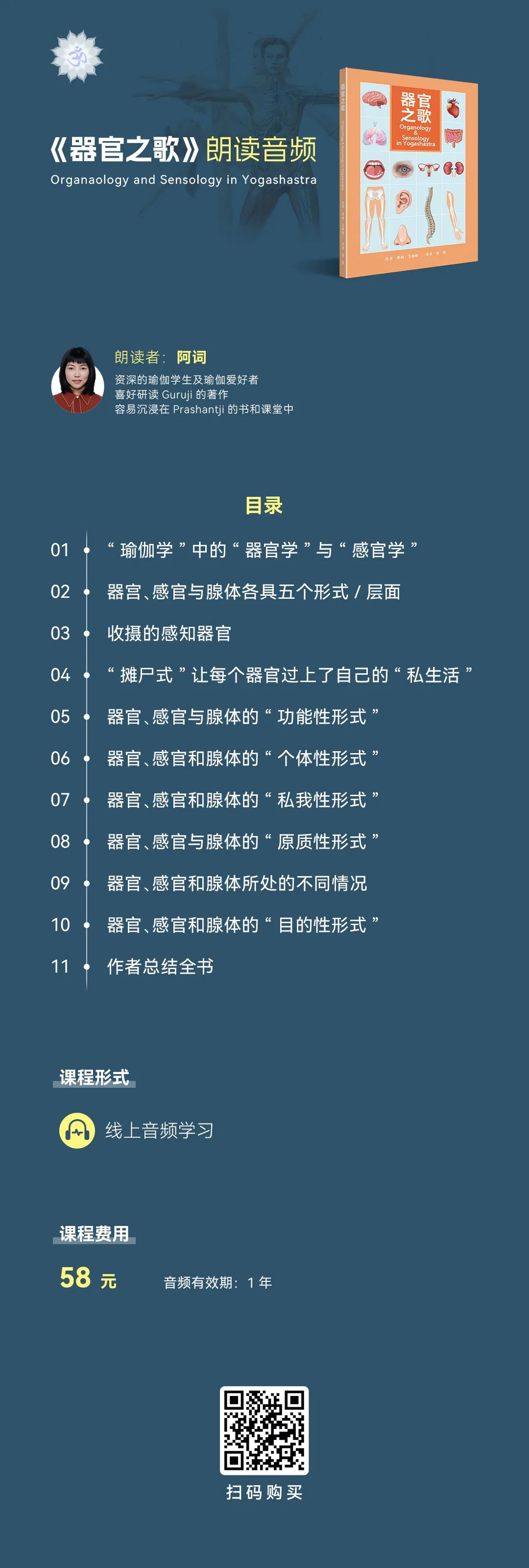

上圖為作者的官方學習平台, 如有微信帳號, 可在作者的學習平台直接購買.
本平台受原作者授權在海外建站, 歡迎與原作者確認 !!

未经授权, 不得转载。
 TW
TW  EN
EN