普尚吉说:
“如果我们要去了解帕坦伽利,
那么就要知道帕坦伽利都做了什么…
瑜伽学,与另外两类学科,
即语法学和阿育吠陀,
有着密不可分的关联,
让我们聆听智者如何解读先哲… …”
现在,
让我们聆听智者对先贤的解读…
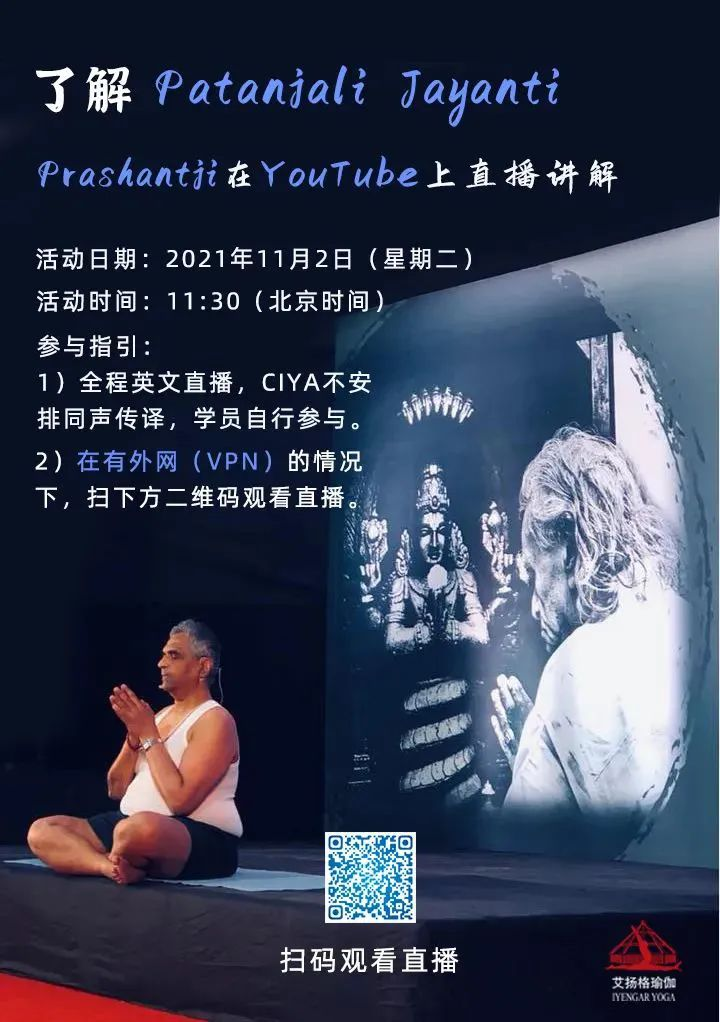
2021年11月2日,
北京时间11点30分,
普尚吉在印度浦那(Pune)“艾扬格瑜伽总院”
发表了“帕坦伽利纪念日”的讲话。
普尚吉提到,
帕坦伽利作为一位先哲,
不仅给了我们《瑜伽经》——
这部专供“意识”(chitta)的传世之作,
还给了我们关于“言语”的语法学论著
(Panini’s exposition on Grammar),
他所论及的“言语”(Vaichika),
绝非世俗意义的语言、讲话,
而是涵盖微妙层面的“言语”,
特别是灵性世界里的“言语”,
比如“默语”、“神语”等等,
另外,
更为重要的是,
我们要专注于构成言语形式的
“基底”、“要素”、“物质”…
————
大家如果对“言语”有兴趣,
可以在此文案的最后附录中,
找到普尚吉在一部专著里面
对这类“言语”的精彩论述。
公务繁忙、家务繁琐…
普通人、女性习练者、
尤其是家庭主妇群体,
如何练出艾扬格大师的瑜伽强度?
普尚吉在纪念讲话的部分结束之后,
对一些问题给予了问答,
下面截取了对第一个问题的部分回答
(原文+中文翻译)
————
We have set the Q&A part,
so one of the questions is,
the question is referred to me:
“You often speak of Iyengar’s Yoga,
because the word we know is:
Iyengar Yoga;
we all know the Iyengar Yoga
the world over.”
其中一个问题是,
这个问题是给我的:
“您常提到‘艾扬格的瑜伽’,
而我们都知道的却是“艾扬格瑜伽”,
因为全世界都这么说。”
But I often refer to Iyengar’s Yoga,
that means:
Yoga that was practiced by B.K.S.Iyengar.
但我却常说“艾扬格的瑜伽”
那就是:
B.K.S.艾扬格所练的瑜伽
Let me give you a ‘dis-illusion-ment’,
because not possible for him to be teaching
the Yoga to you and me
and the whole world
the Yoga that he practiced.
让我来给你们“解惑”:
那是因为,
让他教给你和我他所练的那个瑜伽
是件不可能的事情。
He had his hierarchy,
he had his level,
so what he practiced for himself
was referred to as Iyengar’s Yoga,
that means B.K.S. Iyengar’s Yoga.
Why did he practice for 80 years?
Why are we practicing Yoga?
在他的那个段位上,
他在他的那个水平上,
所以他为他自己而练的,
就被指为:
艾扬格的瑜伽
那就是:
B.K.S.艾扬格的瑜伽
那就是:
Guruji的瑜伽
So we will know that Yoga is different.
You and me, most of us
are practicing Yoga
for ‘healthy’, physically;
for ‘healthy’, mentally.
所以我们都知道,
瑜伽(对于每个人)都是不同的,
你和我,我们大多数人,
都在习练瑜伽,但那是:
为了健康——身体的;
为了健康——心理的;
So what is our yoga
will be decided as to
‘why we are doing it’,
the ‘why’,
will tell about
‘how’our Yoga is.
所以瑜伽对于我们而言是什么,
是由我们为何去做它而决定的,
“为何”将体现出“如何”;
And we are all practicing Yoga
to be healthy,
to be well-being,
in this life, here and now;
we don’t want to face hazzels
in the physical and mental health.
And today Yoga is practiced for that purpose.
And Guruji also taught for that purpose,
for people to be drawn towards Yoga.
我们都是为了
此生、此处、此时的健康与安好,
我们不希望面对身心里的不确定,
今日的瑜伽,
就是为了那些目的而练,
而艾扬格大师,
也是为了那些目的而教,
为了让人们被吸向瑜伽。
But then,
why he practiced for himself?
He was not a health seeker,
he was not a physical and mental health seeker,
whereby he did Yoga for 80 years or more.
但是,
为了他自己呢,
他为何而瑜伽?
他从来都不是一个健康的追求者,
不是热衷于身心的健康的追求者,
但他,却在瑜伽里做了80多年…
Why did he do Yoga?
It is totally different bases
than what we are all doing Yoga.
他为何做瑜伽?
那从根本上说,
就全然不同于我们为何做瑜伽的缘由。
So his Yoga is characterized by why he did it;
and he did not do for the sake we are doing it.
因此,
他的瑜伽,
由他“为何”瑜伽而定性
他做瑜伽
不是为了我们做瑜伽的那个缘由。
Why are we doing it?
health,
mental steadiness,
mental stability,
mental health,
physical health and physical well-being.
我们为何做瑜伽?
为了健康,
精神健康,
精神稳定,
精神健康,
身心的安然无恙
So that,
we can carry out the mundane activity,
the worldly activity,
relentlessly without breaks,
without obstructions, without tempering.
We don’t want ill-health to interfere in our life,
So we know it is not comfortable.
(有了这些健康与福祉),
我们就可以进行正常的活动,
世间的活动,
而且还是:
毫无休止地、一刻不停地、
毫无障碍地、绝不容缓地
进行下去… …
我们杜绝生命中的不健康,
我们知道那并不是舒服的。
But Guruji was not practicing as a health seeker,
corporeal health seeker;
nor psychological health seeker.
Why was he doing Yoga?
The intent was totally different.
但是,
艾扬格大师不是作为健康的追求者而练,
不是作为一个肉体健康的追求者而习练,
他也不是心理健康的热衷者,
他为何一直做瑜伽?
那个意愿截然不同。
So,
he could not be teaching that Yoga to us.
He taught what Yoga is suitable for us,
he taught that to us,
and that is perfectly justifiable,
perfectly right.
He taught what we need to learn
因此他无法把那种瑜伽教给我们,
他只能去教适合我们的那种瑜伽,
他把那个合适的瑜伽教给了我们,
他那么做,
是绝对正当的;
他那么做,
是绝对正确的;
他教我们需要去学的东西。
And
he practiced for
what he wanted to learn
So what you and me want to learn,
what Tom, Dick and Harry want to learn,
and what someone like him want to learn,
are totally different things.
并且,
他练他想学的,
你和我想学的,
张三、李四、王二麻子想学的,
或者某个像他那样的人想学的,
都是完全不同的。
So that Yoga that he practiced,
I often referred to as Iyengar’s Yoga,
that is B.K.S. Iyengar’s Yoga,
that is Guruji’s Yoga.
所以他练的那个瑜伽,
我常常说成是“艾扬格的瑜伽”
“B.K.S. 艾扬格的瑜伽”
“Guruji的瑜伽”
So we are not practicing that;
we do not qualify to practice that.
we are not empowered to practice that;
and therefore,
it is perfectly right
that if you are not practicing that.
所以我们没有在练那个(瑜伽);
我们也没资格去练那个(瑜伽);
我们没有被授权练那个(瑜伽);
因此,
你也自然没有在练那个(瑜伽),
这就对了。
He did not practice
what he taught us
His practice was on a different level.
What he was seeking was totally different
than what we are seeking.
他没有练他教我们的东西,
他的习练在不同的水平上,
他要的,
与我们所要的,
是完全不同的东西。
So I want you to crystalize
that Iyengar’s Yoga is totally different.
所以我希望你们搞清楚,
“艾扬格的瑜伽”
是完全不同的(概念)。
So the question says:
“you often speaks of Iyengar’s Yoga.
So how can one bring a little of that intensity
as a householder, with what seems like
ever in pacing phase of life,
with its endless distractions;
it seems harder being a woman particularly? “
所以这个问题还说:
“你常提到‘艾扬格的瑜伽’,
所以,身为一个‘居家人’,
如何将他那样的强度,
引入那么一点点?
“居家人”
面对着高速运转的生活常态,
似乎有着无尽的分心、干扰,
尤其是对一个女人而言。”
So,
the questionnaire is intending to practice
the intensity of Guruji’s Yoga.
所以这个提问者,
想要去习练艾扬格大师的瑜伽强度。
Is it not important
that first,
we have to understand
the form of His Yoga
难道我们不该首先搞清楚—
他的瑜伽到底是什么形式吗?
So we all very well know that
his Yoga was extremely intense,
so much so that
we could not even with stretch of our imagination,
or even in dreams
or think of that intensity.
我们都很了解,
他的瑜伽极强,
强到了这个程度,
以至于我们甚至都无法用我们展开的想象
或是在梦里、或者是连想都不用去想——
他的那个强度。
So the question clearly says:
how that intensity can be practiced by householder?
Let me bring this to let you know,
that Guruji was also a householder,
he had a huge family,
we are six children.
So he was also a householder.
在这个问题里,
它明确提出了,
居家人如何能练出那个强度。
让我来让你们明确这一点:
艾扬格大师也是一个‘居家人’,
他有一个大家庭,
我们是六个孩子(的大家庭),
所以他也是一个‘居家人’…
译者注:householder,是相对于yogi(瑜伽士)、
ascetics(出家人)而言的修行状态,即组建了家庭、
履行家庭与社会责任的修行之人。
The point is:
by Iyengar’s Yoga
you are characterizing the intensity of it.
问题是,
因为艾扬格的瑜伽,
你在定义它的强度。
We look at the intensity,
utterance in intensity;
or maybe intensity of will,
volition, intent, etc.
awareness, etc, etc.
那就看看这份强度吧,
强度中都表达出来了,
或者说是意志、决心、
意愿等等,觉知等等。
We all know,
it was because of extraordinary will power
extraordinary resoluteness,
extraordinary ‘physicalibility’,
mental-ability with which he worked.
我们知道,
正是源于:
超强的意志、
超强的决心、
超强的体力、
超强的心力、
他才达成的。
But nowhere it is suggested
that you will emulate his intensity.
No,
we are not even suggested
to emulate the mode of his practice.
Because then it will be highly impossible.
但是,
可曾在任何地方建议过
你要去模仿他的习练吗?
没有。
我们甚至不被建议去仿效
他的习练模式
因为,
那将是极其不可能的事情。
Because many of you know about the life of Guruji,
he used to say that
he was practicing 8, 10、12 hours a day.
因为我们大多数人都了解艾扬格大师的生活,
他过去常说
他每天会练8、10、12 小时。
So that will be impossible for us
to allocate 8, 10, 12 hours a day.
Even if we are given time,
we don’t know what to do with 10 to 12 hours.
所以那对于我们而言,
不可能每天分配出8、10,12个小时;
哪怕我们有这么多时间,
我们也不知道用10到12小时能做些什么。
Suppose you are given time,
and you have 8 to 10 hours a day,
nobody will disturb you,
nobody interfering,
what are you going to do for 10 to 12 hours?
Do you have materials for it to do 10 to 12 hours?
We don’t have materials to do in 12 hours.
假设你有时间,
你每天有8到10个小时,
没人打扰你,
没人在干预,
你打算拿这10到12小时做些什么呢?
我们不具备12小时里可以习练的资本。
So that is why we think,
we characterize Guruji at his intensity,
we are not supposed to emulate him.
所以那就是为什么我们会如此去认为,
我们会用他的强度去定义艾扬格大师,
而我们原本就不应该仿效他、赶上他。
The form of Yoga,
in a sense,
the quintessential aspect of his Yoga,
Why was he doing his Yoga?
to some extent,
you must understand that.
瑜伽的形式,
从某种意义上说,
应该是精髓层面上
他的瑜伽
他为何做他的瑜伽?
到了一定程度,
你必须要去搞懂它。
And in our capacities and capabilities,
you must practice that.
What I mean to say is that:
if you are practicing two hours, one hour a day,
why not devote 5, 10 percent of the time
and 5 to 10 percent of the energy
to try to understand why Guruji did,
can I start in my meagre way?
在我们的能力范畴里,
你就必须练那个精髓;
我的意思是说:
如果你每天只有两个小时、一个小时,
那为何不将这个时间里的5%到10%、
以及这段时间里的5%到10%的精力,
拿来尝试去搞清楚:
艾扬格大师为何而做,
“我是否能够
在我的这个微弱的方式中
也开始那样去做?”
Because Guruji also had a graduation process.
We look at his zenith condition, apex-condition,
but he had a process of making himself.
So there was also a graduated practice,
both in que and quanta.
因为艾扬格大师也有一个“毕业”的过程,
而我们只是看到他的顶点状态、巅峰状态,
但是,他也有一个逐渐打造他自身的过程,
所以,那就成为了一个“结业了”的习练,
从质和量上说,
都已经毕业了。
Not that on the first day
Guruji did the que and quanta of practice
in what he did in his apex, the zenith condition;
very well in his life.
It was graduation.
艾扬格大师也绝非在第一天,
就在他所做的一切当中、
在他的一生当中、
在他的巅峰、顶点状态里,
达到他习练的那个质和量,
其实,那是一种结业过程。
So,when I said
when we practice Iyengar’s Yoga,
do I suggest ‘practicing his intensity’,
‘emulate him’?
because,
philosophy does not endorse these emulations.
所以当我说,
在我们习练艾扬格的瑜伽时,
我可曾说过要练他的强度吗?
我可曾说过,
要去仿效他吗?
因为(瑜伽)哲学不鼓励仿效。
Because our matter is one,
and somebody else’s matter is something else.
We have to work with our own matter,
our own potentials.
We must understand our own potentials,
and use the potentials,
and try to practice
the Principles of Yoga
因为组成我们的物质是一种类型,
而别人的物质又是别的一种东西,
我们必须用我们自己的东西去做,
我们自己的潜质,
我们必须明白我们自己的潜质
并且去运用这些潜质,
还要尝试去习练瑜伽的原理…
So we must have idea
why Guruji was doing his Yoga.
Can I do the same
5 percent of my practicing time?
Can I allocate 5 to 10 percent time and energy
to really try to have the same‘why’
behind our practice.
所以我们必须有这样的概念:
即艾扬格大师为何做他的瑜伽,
我能在我的习练时段里,
做出5% 同样的东西吗?
我能分配出5%到10%的时间和精力,
在我们的习练背后,
真的去尝试拥有同样的那个“为何”吗?
So there are infant dosages.
How were you taking your food
when you are an infant?
How are you eating your food
in what que and quanta
when you are eating your food today?
所以就有了“婴儿的剂量”,
你还是个婴儿时
你是如何吃饭的?
而到了今时今日,
你以什么量吃饭?
The mother always feeds the baby with baby dose.
So we have to take baby steps,
even if you are under influence of Guruji
impacted by Guruji,
gravitated by Guruji,
we have to commence infant dosages.
母亲总是用婴儿的剂量去喂宝宝吃饭,
我们也必须要先走婴儿步,
即使我们在艾扬格大师的影响之下,
即使我们在艾扬格大师的冲击之下,
即使我们在艾扬格大师的吸引之下,
我们要用“婴儿的剂量”去开始…
And by far
that we can find why he was doing it.
而且这样去做,
我们就能发现
他为何做瑜伽。
We go to a parent-cive,
that you all used to looking at his Light on Yoga,
and see how he had done the postures.
我们都找到过父母般的关照,
你们常常会去看《瑜伽之光》,
也看到了他如何做出那些姿势。
And I often told you
asanas are not postures
而我常常告诉你们:
——体式不是姿势;
If you look at it as postures,
the postures he did
in prime time of his age,
and later past 85, 90,
the postures were different.
你不要把它看成姿势,
他在他巅峰时期所做的姿势,
后来,
过了85岁、90岁所做的姿势,
那些姿势都是不一样的。
The postures are different matter here,
and we are thinking,
when we look at his postures,
abilities, capacities,
prowess, skill,
presentations and then
we are trying to emulate.
在此所说的姿势,
是完全不同的东西,
而我们只会想到:
能力、才华、
力量、技巧,展示,
然后,
我们就尝试去模仿。
So basically understand
we are not supposed to emulate.
Guruji was not emulating someone.
Guruji identified his potentials,
his intrinsic nature,
he identified the trump card in him,
and the place his trump card throughout his life.
因此从根本上要去理解,
我们本就不应该去模仿。
艾扬格大师也没有模仿任何人,
艾扬格大师认识到了他的潜质,
他认识到了他内在固有的本性,
他认识到了他自己的那张王牌,
并且将他的牌贯放进他的生命。
Now we cannot put trump card of Guruji
and succeeded in our own playing cards.
We must know what is our own trump card.
4 people are playing cards,
4 people have different trump cards.
Because your icon is having particular trump cards,
you cannot just be using that as your trump card.
我们现在不能将大师的王牌
继续放到我们自己的游戏里,
我们必须知道,
什么是我们自己的那张王牌,
4个人在玩牌,
4个人有着不同的王牌;
你的偶像有张特殊的牌,
你不能用他的牌去打你的牌…
So Yoga actually takes you inwardly.
First of all,
identify your potentials.
So,
Guruji was venturing his own potentials,
understand the potentials,
and then use the potentials,
structuring the potentials,
and therefore,
he became what he became
所以,
瑜伽实际上在引领你向内而行,
因此首先要去认识到你的潜质;
所以,
大师一直在探索他自己的潜质,
一直去弄清楚那些潜质,
然后,
去运用那些潜质,
去打造那些潜质。
所以,
他就变成了他…
So,
we need understand what is behind Guruji’s Yoga.
and slowly take steps towards it.
But if you think of doing something as Guruji did
for you sight and for your vision,
then you will get these problems.
我们也必须要懂得
艾扬格大师的瑜伽背后是什么;
但如果你只想着大师做了什么,
只看到那些,
而且是为了你的视线、为了你的观感,
那么你就会出问题。
Now if the distractions are coming,
and of course,
we know this,
we will get distractions in more or less degrees.
but it is a universal problem.
Why do we get these distractions?
如果干扰、分心发生了,
当然,
我们多多少少、不同程度地
都会被干扰而分心,
但那是一个全世界普遍存在的问题,
(关键是),
我们为何而分心?
Because we do not go deep rooted,
towards deep rooted knowledge.
We did peripheral knowledge every time.
And therefore,
we have distractions potentials.
因为我们没有扎向认知的根处,
我们每一次都只是在做表面的,
因而我们就获得了分心的潜质。
So,
the depth will help you overcome the distraction problem.
If you are on the surface of the mind,
then the distractions are lot;
when you slightly dive deeper into the depth,
distractions will be lessening.
因此,
深度,
才会帮你解决问题、
解决分心的问题,
如果你的头脑处于表层,
那么就会有大量的分心;
深潜那么一点,
则会进入到更深处,
分心会因此而减少。
The point is:
to overcome the distractions,
we need to have penetrations into our practices,
So there will be less chance of distractions and hindrance.
重点是,
为了克服分心的情况,
我们需要在我们的习练中去深入,
那就会少一些分心、少一些阻碍… …
听写、翻译:梁洪
附录
摘自普尚吉著作
暂定的中文书名是《行为之歌》,
《YOGASANA——18 Maha Kriyas of Yogasana》
中文译本出版在即,敬请期待。
……
现在,我们需要搞懂“言语”(speech)这一概念,因为它频繁出现在玄学和灵性学当中;有四种类型的“言语”,即:
发出声音的言语(Vaikhari)
没有声音的言语(Madhyama)
言语形式的基座(Pashyanti)
至高无上的神语(Para)
“言语”,即用词语形式进行表达的方式(词语——带有语法的一门语言)、或基于一门语言的词语发音形式;这种“言语”的类型在玄学和灵性学当中即被称为‘Vaikhari’。这是“言语”的一种功能,它会使用舌头、上颚、牙齿等部位,并且对另一个人而言,它还是一个听觉对象。词语是由字母构成的,而字母则是元音、辅音、元音化的辅音;‘Vaikhari ’即相当于用语音要素表达出来的“言语”。
然而,根据印度古老的智慧,还存在一种静默的“言语”方式,即‘silent speech’——“默语”,它是作为语音要素和发声言语方式的“基座”而存在着;这不该被错误地当作头脑(mind)及其念头/想法/思想(thought);“默语”是:
“一个人在心里说话”
(speaking within one’s mind)
但这却不等于所谓的“心念”,这样的“言语”在灵性中,它被称为‘Madhyama’,在帕坦伽利《语法修辞学》(Panini’s exposition on Grammar)的阐述中,它被称为‘Vakaran’,即“默语”。默语又得到了‘Pashyanti’的支撑、支持,所以‘Pashyanti’成为了‘默语’的基础或底座;‘Pashyanti ’字面上的意思是“见”/“看”(to see)、或“所见/所看”(seen or sighted),它囊括了我们逐渐建立起来的思想以及之前(甚至包括前几世)的全部经历,它们全都被存储在(凿刻在)我们记忆的“银行”里,这就形成了我们思想和言语的基础;“言语之基座”(Pashyanti )也就因此暗存于“默语”之下,而且“言语之基座”还得到了“神语”(Shakti)的支持。‘Shakti’是宇宙原初的言语方式,它被称为 ‘Para’;‘Para’的意思是至尊无上的,‘Para’即我们内在那股原初的神力。
因此,从因与果(cause and effect)的角度去看,“神语”就是言语的根因(the root cause),而“神语”的“果”即“言语的基座”(Pashyanti);“言语的基座”即“默语”(Madhyama)之根因;“默语”又是“正常言语”之“果”。根据灵性学和帕坦伽利语法修辞学的哲理,这才是“言语”的全部过程;概括起来,“言语”的过程包括:
Vaikhari(发声的)
Madhyama(静默的)
Pashyanti(起源的)
Para(神性的)
所以,“神性的言语”相当于言语这棵大树的根,而“发声的言语”只是树冠;“言语行为”在本章当中指的就是这个“默语”—— 在心里说的话。
我们不该混淆这二者,“默语”与“正在思考的头脑”(the thinking mind) 或“头脑的想法”(thoughts of the mind)或“头脑当中的想法”(thoughts in the mind) ,二者之间的区别是很容易辨别的。
头脑的想法或头脑中的想法并非处于我们的掌控和规范之下,我们经常感觉到,任何念头都可以进入我们的头脑,甚至违背我们的心愿。什么念头会进入我们的头脑,那是无法被预见的、被预期的,已非“心想事成”,这些念头真的无法被杜绝、或被避免;但是“默语”却可以在我们主动的掌控之下,我们可以在它之上行驶我们的控制力。
“默语”和“头脑的想法”是不同的。关于“默语”,据说智慧和明睿之人宁愿“隐退”到默语中去,也不愿喋喋不休;疯子以及清醒的人,也会静默地说话,只不过,精神正常的人不会让他们的默语和念头通过他们的言语器官将默语扩音出来;而疯子,对于什么可以说出去、什么不可以说出去,就毫无这样的控制力或选择力,蠢人和疯子是毫无分辨力地隐退到默语里的。
我们的头脑和言语存在着明显的不对等,言语和头脑之间的基本区别其实是非常明显的。,如果言语方式(即言语文化)必须要与头脑相互协调,那就要仰仗于一个人在灵性方面的进化程度。灵性所期望的是二者之间完全的忠诚和相互对等,这二者都需要得到改善和提升,而瑜伽就拥有一条让这二者实现对等的路径。“言语”需要被调到“神语”的频道上,“神语”之外的三种言语类型都需要在这条进化的过程中得到提高;因此至关重要的是:我们要关注到这三类“言语”的改良,即:“发出声音的”、“静默的”、 “言语之因”,还要将它们设置到与“神语”完全契合、对等的状态。
体式中存在着“言语行为”,它绝大部分属于“默语”,并且还独立于声音以及/或者语音系统的支持,比如言语器官、“扩音器”、嘴唇、舌头、牙齿、上颚、下颚等。这类“言语”没有声音要素、没有声音形式、也没有为了达到传声效果所产生的“声波物质”;说到这里,我们完全可以这样说:它是头脑当中的默语(silent speech within the mind)… …
 TW
TW  EN
EN