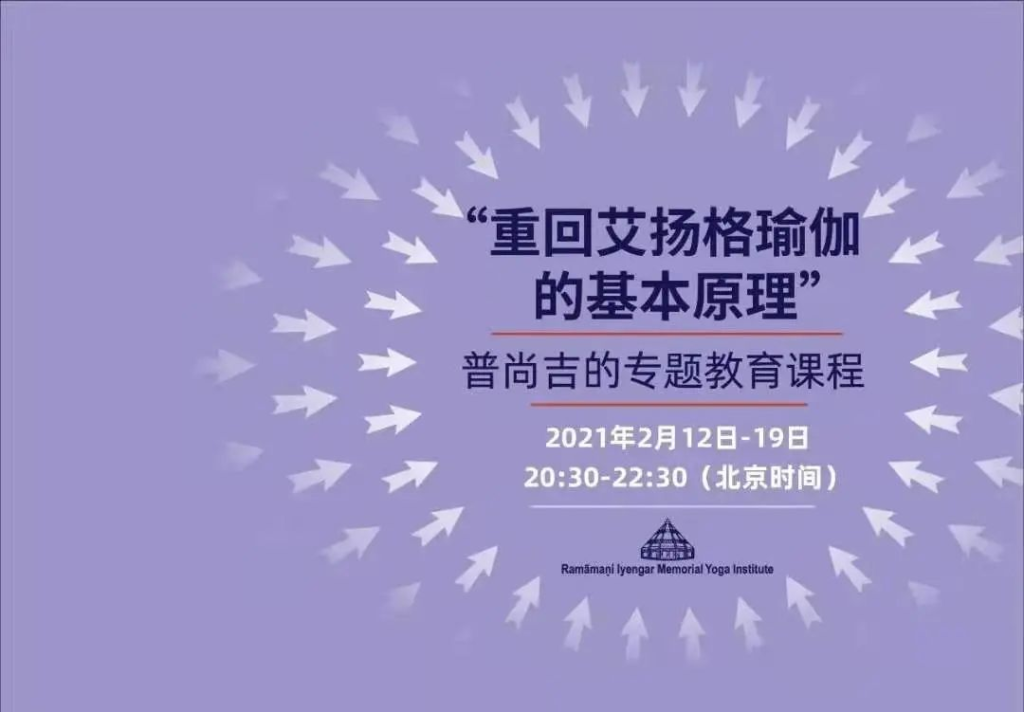
在我们即将结束普尚吉全球2月课程之际,
即“重新探访瑜伽基础、艾扬格的瑜伽基础”
也让我们重新认识一下普尚吉,Sri Prashant S. Iyengar。
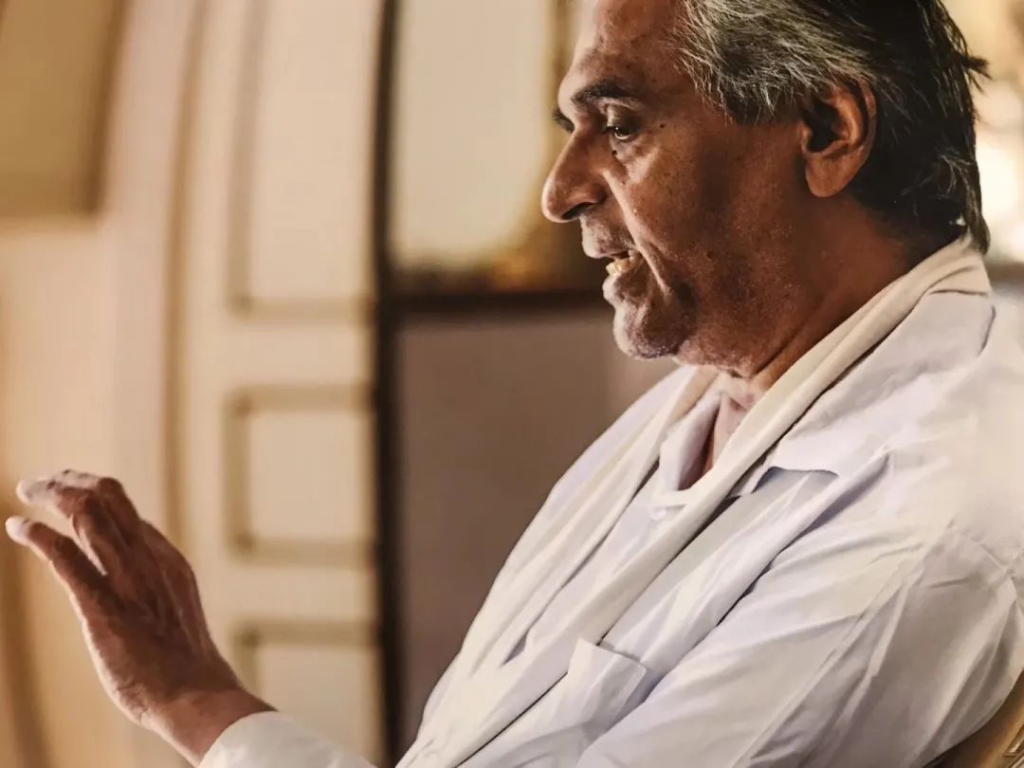
普尚 艾扬格,
B.K.S. 艾扬格大师之子,
也是太阳之子。
艾扬格大师,
就是那个太阳,
他将炽热的光辉、光芒、智慧
撒向世界,
让我们所有人,
都能领受到这份恩泽,
特别是他挚爱的弟子们;
而普尚吉,
则一直是那个月亮,
静静地反射着,
父亲兼上师的教诲之光。
如果太阳很难用肉眼去直视,
尝试直视它的人,
会因它的炽热和能量
几乎双目失明;
而月亮,
却是可以直视的;
它会让人遁入深思;
它会将冷俊的银色之光
弥漫开来,
让人沉入梦乡···
普尚吉的人格,
恰恰显示出这样的魅力,
正如他的名字
——尤如深深的蓝色太平洋
——Prashant Mahasagar;
总是那么平静、
深沉、
淡定。
当月亮因巧合,
运行到地球“旁边”时
它大如圆盘,银光四射,
会超出平时亮度的百分之三十,
这样的月亮,
人们称它为“超级月亮”。
自2017年12月起,
即艾扬格大师百年诞辰的启动之际
普尚吉,
就像那轮超级明月,
开始贴近他的弟子们,
与学生在一起的时间,
也增多了不少;
开设出众多的课程,
就是他“见”弟子的方式。
这些教育,
点亮了“瑜伽本质”的主调之光,
而“艾扬格瑜伽”,
不属于这一本质,
但“艾扬格的瑜伽”,
却体现了这种本质。
引用普尚吉的原话:
“瑜伽里总有些什么,
可以给到每一个人”···
以上内容译自:
拉玛玛尼艾扬格纪念学院院刊《瑜伽之道》
Yoga Rahasya 2019, Vol 26, No.4
翻译:梁洪
肩倒立为何是一个可以给头脑
“降燥”、
“排酸”、
“冷却”的体式?
Today’s precept was about
how much your posture can work on your physiology,
because,
breath is said to be another side of the mind.
今天的概念是关于
你的姿势如何作用在你的生理状态上,
因为,
呼吸据说是头脑的另一面。
If I am angry,
it is not really directed to the breath
which is also another side of my anger,
it is my anger-potential,
which is really pumping up the anger in me.
如果我生气了,
那真的不会指向呼吸,
虽然它也是我生气的另一面,
还有一面,
是我生气情绪里的潜在因素,
那才是激发我生气的“根”因。
Yes, the breath will be modified by my anger.
When you are angry,
your membranes go apart.
That is the physiognomy of anger.
Somebody angry, as I said
there is a vernacular expression,
it has reference to nose on someone’s anger.
是的,呼吸的确会因我生气而发生变化,
当你生气时,
你的鼻孔会张大,
那就是生气这个情绪的面貌、样子,
某人很生气,我以前说过,
(印度)当地人有一个自己的说法,
“生气”会指向这个人的鼻子。
The breathing will be modified,
but that is not really the causal factor;
the causal factor is anger potential in me,
which is blasting the anger in me,
exploding the anger in me.
呼吸会(因生气)而变,
但那未必真的是因果性质的原因;
因果要素,
才是我生气的内在潜伏因素,
是它在我的里面喷发出怒火,
在我的里面爆发出怒气。
If you want to overcome anger,
you don’t have to improve
the person who are around you,
the things around you,
so you won’t get angry.
如果你想克服愤怒情绪,
你不必去改善你周围的人、
你周围的事,
然后你就不会生气了。
No.
That is not the way of management of the anger,
you have to work on anger potential,
and Yog works on anger potential,
because it is process of consciousness,
and it has processes for consciousness.
不是的,
那不是管理愤怒情绪的方式,
你必须作用在愤怒情绪的潜在根源上,
瑜伽,就会作用在愤怒潜在的根源上,
因为它是意识的演化之路,
它对于意识而言,
拥有各类“加工”手段。
So,
what the body does for breath,
what the body does for mind
is also matter for observation;
rather than
the breath does for body, or
the mind does for body,
because it is a corporeal process/approach/gravity,
that we try to be certain:
‘yes, breath is good,
let us use the breath to body,
I exhale/inhale more, benefit to body,
my mind/intent/resoluteness/will, body has all the benefits’.
所以,
身体为呼吸做了什么,
身体为头脑做了什么,
也是要进行观察的方面;
而不是
呼吸只为身体而做,或
头脑只为身体而为,
因为这是世俗里的路径/方法/吸引力,
我们总是企图去确定:
“哦!呼吸好,是吧?
那就让我们用呼吸去为身体服务吧,
我更多地呼、吸,身体就一定会获益,
再用上我的头脑/意向/意志力/意愿,
身体定会从中获益。”
In Yog,
you are not supposed
to give benefits to body
limitlessly…
to its extend,
it is a potent instrument,
because,
the contribution has to go to:
mind related to breath,
not mind related to brain or heart,
the mind related to breath,
that is the potential factor in our mind.
在瑜伽当中,
你本就不该无休止地、
只给身体带去好处,
说到底,
它也只是一个有力的工具而已,
因为,
收益应该给到:
头脑与呼吸的关联,
而非头脑与大脑或心的关联,
一定是头脑与呼吸的关联,
那才是我们头脑的潜在要素。
…Go to sarvāngāsana.
进入肩倒立···
Now,
teachers will tell you precise sarvāngāsana:
‘elbows closer,
raise the back,
index finger on the rib, etc.
sternum perpendicular,
shoulders back,
trunk perpendicular,
buttocks tight,
legs straight,
feet/toes together’… …
So much of attendance to body
in this ‘yog-aaaa’,
which I express as
yog + double ‘a’– double ‘a’.
此时,
所有的老师们都会告诉你
如何完成精准的肩倒立:
“双肘靠近,
食指抵在肋骨上,等等,
胸骨垂直,
肩膀向后,
躯干垂直,
腿要伸展,
脚/脚趾并在一起”
如此之多的关注,统统去向了身体,
这就是“激进式瑜伽”里的东西,
我将其称为:
瑜伽这个词yog,
后面加上两个‘a’,
再加上两个‘a’,
(*译者注:发音就成了拉长的‘yogaaaa’)
But see,
how sarvāngāsana a breath conditioner!
your very mechanical involuntary breathing
will be totally different than your breathing otherwise,
the mechanical involuntary breathing.
So it is significant modification
in mechanical involuntary breathing.
但是,要明白,
肩倒立如何是一个呼吸的”调节剂”,
正是你此时这种机械性的非自主呼吸行为,
恰是不同于你正常呼吸的呼吸行为,
它是一种机械性的非自主呼吸形态,
所以那是发生在机械性非自主呼吸当中的
一个明显的变化。
Now watch,
it is a typical breathing in sarvāngāsana ,
particularly independent sarvāngāsana
if you are doing,
where your exhalation will be quite a prominent factor,
your inhalations will be reactions of your exhalations.
That is a different case in sarvāngāsana .
you can involuntarily inhale.
现在去观察,
那是肩倒立当中典型的呼吸模式,
如果你做的是无支撑、独立的肩倒立;
你的呼气,
在这样的情况下,
会是一个凸显出来的要素,
而你的吸气,
将是你呼气的一种自然反应;
这就是肩倒立中的特殊情形,
你可以进行非主动性质的吸气。
So,
have you ever taken cognition of this?
that sarvāngāsana is an exhalative pose,
independent sarvāngāsana,
is an exhalative pose!
It is not so much inhalative pose,
independent sarvāngāsana;
it is a different case for chair sarvāngāsana,
so you think it as alternative.
你可曾留意过这个现象吗?
即肩倒立是一个呼气性质的体式,
独立完成的肩倒立,
是一个呼气性质的体式、是以呼气为主导的体式;
独立完成的肩倒立,
不是一个吸气性质的体式、
不是以吸气为主导的体式;
但在椅子上的肩倒立中,
这个情况又会不同,
但你们,
却认为椅子上的是一个变体。
Let me tell you,
it is not an alternative.
Yes,
if you are not able to do this at all,
you can take recourse to a chair in savangarsana;
but in dynamics of it,
in its output of it,
it is not alternative.
让我来告诉你们吧,
那不是变体。
是的,
如果你压根儿做不来,
你大可以求助于椅子完成肩倒立,
但在它的动态行为中,
在它的实际产出中,
那不是一种变体行为。
Now see,
the Inhalations go to background,
exhalations will take place, more prominently.
So it won’t be proper for the instruction,
that you in sarvāngāsana :
you inhalation deeper!
现在去看看,
吸气,隐退到了“后台”,
呼气,更多凸显了出来,
所以,
向你发出肩倒立中这样的指令:
“你要深吸气!”
就不合适了。
Because,
it is not a condition for you to be inhaling, deeper.
It is reaction of your exhalations.
It comes as reactions to your exhalations.
So it is an exhalative pose,
so independent sarvāngāsana,
is an exhalative pose.
因为,
那不是一个你可以进行深吸气的处境,
深吸气变成了你呼气的反应,
它是作为你呼气的反应而进行的,
所以,
它是一个呼气为主的体式,
无支撑、独立的肩倒立,
是一个呼气性质的体式。
If you want to have
effect of independent sarvāngāsana
in chairs sarvāngāsana,
make it an exhalative pose;
however,
you can also be making it exhalative
in chair sarvāngāsana ,
so it will be becoming closer to
the effectualities of independent sarvāngāsana,
despite being on the chair.
如果你想在椅子上
也产生出独立肩倒立的功效,
那就让它成为一个呼气性质的体式;
虽然你在椅子上,
你其实也能让它成为:
“呼气性质”的体式,
它会逐渐贴近独立肩倒立的效果,
即使在椅子上进行。
Suppose you have bounty of acidity,
you don’t want to take
salty things,
pungent things,
hot things,
you refrain from taking these things,
because of the acidity.
You take alkaline inputs.
You don’t take acid inputs,
you take alkaline inputs
because of acidity problem.
Similarly,
sarvāngāsana is an exhalative pose,
for such a reason.
The acidity of your mind
will come down,
for such a reason.
假设你有严重的反酸现象,
你不会想摄入
咸的东西,
刺激性的东西,
辣的东西,
你会远离这些东西,
就是因为反酸的问题;
同样的,
肩倒立,
它之所以是一个以“呼出”为主的体式,
恰是因为
你头脑中的“酸性物质”
在肩倒立中会降下来。
This concept has not come to modern science.
They only refer to acidity in our body,
but it is acidity of mind which has outputs
such as anger/ exasperation/ intolerance.
That is the acidity of the mind.
这个概念还没有被现代科学发现,
他们只是指我们体内的酸性物质,
然而,
头脑也会产出它自己的酸性物质,
比如生气/怨恨/难以忍受等等···
Sarvāngāsana,
will give e alkaline inputs.
So when you say:
sarvāngāsana makes your mind quiet,
you should look at the structure of that quiet mind,
it is because anger/intolerance potentials
has gone down,
depleted levels,
anger potentials.
go to depleted levels.
肩倒立,
会给你“碱性平衡”的输入,
所以你才会说:
肩倒立让你的头脑安静下来了。
但你该这样去看待安静头脑的结构变化,
那是因为生气的潜在要素
降下来了;
生气的潜在因素,
进入到下降的水平。
So,
if you are a student of Yog psychology,
you will start having this analysis,
and your readings should be like this,
rather than the consumer mind says:
‘Oh!
sarvāngāsana makes me quiet,
I felt quiet, after sarvāngāsana .
I feel serene.’
所以,
如果你是瑜伽心理学的学生,
你就会开始进行这样的分析,
并且你的解读也应该是这样的,
而不要像一个普通的瑜伽消费者,
声称:
“哦!
肩倒立让我安静,
我在肩倒立之后感觉平静了,
我觉得很安详。”
Opposite to serenity,
is acidity of the mind;
serenity/quietude,
is alkaline of the mind.
Opposite to the acidity,
is the serenity of the mind.
安详的反面,
即头脑的“反酸”;
祥和/沉静,
皆为头脑的“碱面”;
“反酸“的反面,
即头脑的祥和;
Therefore,
inhalations are not taken as input.
When your acidity pops,
you don’t take hot /salty/pungent things,etc.
That is why I have often been saying:
these are chemical processes.
因此吸气,
绝非作为一种主动的输入,
当你的酸性物质爆棚,
你不会去吃咸的/刺激性的东西,
那就是我为何反复强调:
这些都是化学反应的过程。
So,
start developing this kind of perspective,
otherwise you are all dealing that:
‘asanas are something physics’,
‘there are physics in asanas’,
because you are dealing with the physical body,
physics, which is body.
所以要开始去开发出这种视角,
否则你们总是这样对待体式:
把它们“当作物理的东西”,
“体式里有物理学,
那是因为你们在处理表面的身体,
那也的确是物理层面的,
即身体层面。
The Body,
is governed by physical laws,
but,
the body is functioning under chemical processes;
the body,
is governed by physical laws,
but,
the body is functioning with
chemical processes
bio-chemical processes,
electrical-chemical processes.
身体,
是由物理原理掌控的,
但是,
身体却只有在化学反应之下
才能发挥其作用;
身体,
是由物理原理掌控的,
但是,
身体却只有随着化学反应
才能发挥其作用;
随着生-化过程;
随着电-化过程;
Have this dimension in your thought process,
these are chemical processes,
these are bio-chemistry
electrical-chemistry processes;
there are bio-chemistry handles,
bio-chemistry
electrical chemistry
prominently working!
要在你的思想过程中,
去建立这样的思维,即:
这些都是化学变化的过程;
这些都是生化/电化的过程;
生化/电化在实际掌控,
生化/电化过程,
明显地在发挥着它们的作用。
So in halasana,
arms over the head,
arms relaxed over the head,
arms sideways,
arms behind,
interlock fingers behind.
所以在犁式中,
手臂举过头顶,
手臂放松着举过头顶,
手臂在身体两侧,
手臂在身后,
十指交扣。
Do you think it is only physical modulations?
No!
These are modifying the chemistries!
These are modifying the chemical processes,
bio-chemical processes,
once you develop this approach,
We are handling chemistry,
we are in chemical processes,
Then,
your approach will be changing for good.
你们还认为这些只是身体层面的微调吗?
不是的!
这些在改变化学原理,
这些在改变化学过程,
生化过程;
一旦你开发出了这种(观察/研究)方法,
这些就会成为化学反应的过程,
生化反应的过程。
我们正处理化学变化的过程,
我们正处于化学反应的过程。
然后,
你的方法就会永远性地发生改变。
If you look at the physics of this,
physical dimension of this,
physical means,
not referring to body, but physics,
subject of physics,
because that reflects the physical,
gravity, anti-gravity, the shape, the form etc.
if you are in the sense of physical dimension,
physics dimension in position,
you will never board
the bus of Yog,
or the train of Yog,
or the plane of Yog.
So look at this as chemical processes.
但如果,
你坚持从物理层面去看它的话,
从物理的维度去看它的话,
这里说的‘physical’,
不是指身体,
而是指“物理”这门学科的那个“物理”,
因为身体反映出物理的概念,
比如重力、反重力、形态、外观等;
但是,
如果你逃脱不出这个物理层面,
深陷于姿势中的物理维度,
你将永远无法登上瑜伽
这趟公交,
或这列车次,
或这次航班···
所以要将这个看作是化学反应的过程。
Since the class today,
I had so many assemble-ments
and dis-assemble-ments,
because I want to
communicate some certain precept of Yog,
that we
dissembled,
re-dissembled,
re-assembled,
re-dissembled.
今天的课从一开始,
我就进行了大量的组装工作
拆卸工作,
因为我想
将瑜伽的一些理念告诉给你们,
那就是为何要进行
拆;
再拆;
再装;
再拆;
Now you have to invest your thought process,
like in case of jigsaw puzzle.
You remove from the box,
then you want to re-arrange it,
and you will have the manifestation.
现在轮到你们投入到你们的思想过程中去,
就像在做那种拼图游戏,
你把盒子打开,
你想重新组装它,
然后你会拼出一样东西。
Today,
I gave you this set of jigsaw puzzle.
Now,
you have to invest your thought process into it
to look at the assembly to understand
Yog will manifest out of it.
今天,
我给了你们一套”拼图游戏”,
现在,
轮到你们投入到思考过程中去,
去看看如何进行组装,
去理解瑜伽就是从这里呈现出来的。
If the jigsaw puzzle will manifest in elephant,
each piece will have potential of elephant,
but how far the elephant actually?
Not at all.
It is only potential which will be actualized,
only then you will properly arrange the pieces.
If you don’t arrange properly,
where are you going to have the elephant?
如果拼图游戏要拼出大象的图案,
那么,
大象的每块拼图都会有大象的潜在要素,
那离实际的大象图案会有多远呢?
一点都不遥远,
只要每一片潜在的图片都实际到位,
你才会正确地将它们一一地拼出来;
如果你没有排好,
你到哪里去拼出这头大象呢?
So that is why
precept of the today’s asanas in the class
will be like this,
the pieces of the jigsaw puzzle.
Now for you to have proper ideation,
proper crystallization,
you have to have your thought process,
just like you invest your thought process
to arrange your jigsaw puzzle:
what should go where?
所以那就是为何
今天课程里体式的概念就像这幅拼图,
拼图游戏里的全部散件,
现在轮到你们去形成正确的概念
正确的理解,
你们必须要有你们自己的思考过程,
就像你们在拼图游戏里要动脑子:
该把什么放到哪里去?
So,
try to luminate all the precept of the class:
collect them,
then,
try to go for their arrangements
when you do your asanas.
所以,
尝试将这堂课的所有概念都清晰起来,
当你自己做体式的时候,
把它们都搜集起来,
然后,
尝试将它们组装起来。
节选自《重回艾扬格瑜伽基础》 2月14日第3节课
体式的目的及其副产品
体式可以正面而积极地作用于chitta,即意识层面,可以提升它的状态、质地;可以去培育它、使其健康。在这个过程当中,势必会相应地产生出对身体的影响,身体和意识也一定会彼此影响。如果chitta得到了培养、使其获得健康,那么身体也会得到滋养、由此而获得健康; 反之亦然。瑜伽体式主要作用于chitta,并且在身体上也会产生相应的改变;换句话说,瑜伽体式不是为了身体的力量、功效、高超的技艺和健康,但所有这一切会随之而来。从技术上说,它不过是瑜伽这个“加工”过程中的一个“线外”产品。
体式总是普遍被视为身体和生理的锻炼,有些人习练瑜伽是为了身体健康,同时认定,那是一项神圣化的锻炼方式(a holistic exercise),这是瑜伽中的“假象”(‘maya’in yog);由于这个假象,人们正在为了副产品而奋力地习练体式,就好像它才是主要产品,不但如此,这个副产品还居然变得比主要产品更重要。显然,老师们、学生们、习练者们以及瑜伽体式的初学者们,全都将重点放在了副产品上,并且全都在夸大这个副产品的作用和功效。这个副产品如此迷人,乃至主要目的早已被抛在脑后。这不仅是一个错觉(maya),还是对瑜伽的一种极大歪曲。今天,瑜伽这门学科被传播到如此泛滥的地步,正是因为这个副产品对于追求物质成果的人来说,显得更为重要。
现在,让我举一个例子来解释一下这个说法。试想一下,某人为了工作的缘由,需要在普纳(Pune)和孟买(Mumbai)之间搭乘火车进行商务旅行。那些熟悉这段旅程的人都知道,在这条线路中,乘客会经过‘Lonavala’和‘Karjat’这两个站,这两个地方因一种叫做‘batatavada’的小吃而出名。许多乘客都会在旅途中享用这道小吃;但这并不意味着,乘客选取这段线路的目的,就是为了在这两站去吃‘batatavada’,它只是一个副产品,只是这段旅途的一个顺带之物。
瑜伽体式,是为了那个特定而清晰的目的而习练,它是为了chitta而习练。但在这个过程当中,身体也沾了光,也获得了正面和积极的改善与提高;但如果一个人因此而得出结论:“体式是为了身体的好处而为”,这就相当于说,几百号乘客,在普纳和孟买之间来回穿梭的目的,就是为了去吃‘batatavada’。
课程内容:普尚吉
听写、整理:梁洪
翻译:梁洪
编辑:任小楠

未经授权, 不得转载。
 TW
TW  EN
EN