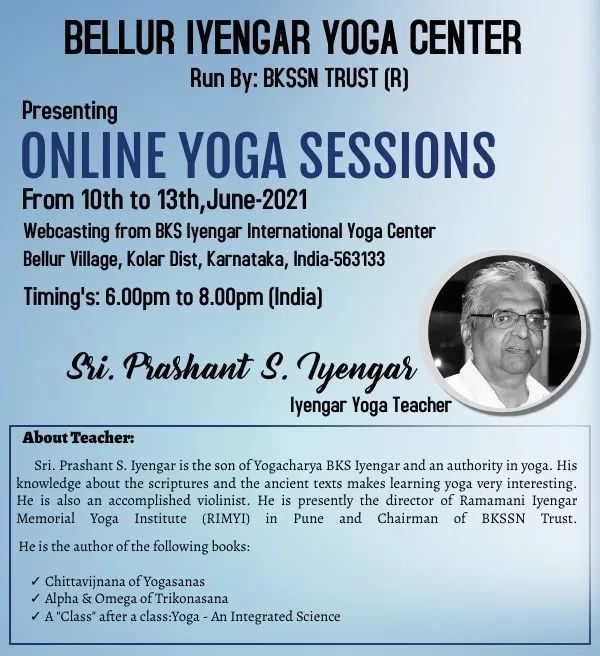
2021年6月10至13日,普尚吉为艾扬格大师的故乡百勒尔基金会开设公益网课,让我们分享其中的精彩片段。
In pranayama,
only oral act, silent uttering,
all magic will take place after.
It is all magic,
such technology;
that is the exploration to the embodiment
by Yog,
by yogis,
by science of Yoga,
by system of Yoga.
在呼吸控制法当中,
只要开启语音行为、静默的发音,
所有魔法就会在这之后发生。
它充满了魔力,
这个(呼吸法的)技术,
它是对整个生命体的探索
–通过瑜伽,
–通过瑜伽学,
–通过瑜伽这个体系。
Forward/backward bend/twisting, etc.,
when they are not postures,
they have deeper efficacy.
Somewhere carry out this study,
field work,
survey,
on what twisting do for the mind.
前屈/后弯/扭转等等,
当它们不再是姿势时,
就会产生更深入的功效,
要在(体式中的)某处去进行这样的研究;
这样的基础工作;
这样的探寻,
去看看扭转为头脑做了什么。
We all are considering what twisting for boby.
Yes!
it is good for back/back muscles/ abdomen/ chest, etc.
我们都在考虑扭转为身体做了什么,
它的确
对背部/背部肌肉/腹部/胸部都很好。
So we need to carry our very deep, formal observation,
something like in lab-psychosis,
as to what twisting do for the mind;
what inversions do for the mind;
Then what particular asana for the mind?
但我们需要进行更深入的、更正规的观察,
要有一种类似实验室的精神状态,
去观察扭转对头脑做了什么,
倒立对头脑做了什么,
然后有什么特定的体式是对头脑有益的。
These are something
that you need to carry out field work.
Don’t expect that it should be taught,
you have to learn it,
by observation, experimentations, trials, etc.
有些东西,
是你需要去进行基础工作才能获知的,
不要指望被教会那些东西,
你必须自己去学,
通过观察、实验、测试等等。
So what does an asana do for mind?
There must be a major priority for you;
rather than asanas are doing for liver/colon/pancreas,
joint/limbs, etc.
That is why when you have shavasana,
you won’t look for the benefit of liver/spine/chest,etc.
You don’t look for that.
所以体式为头脑都做了什么?
对你而言必定会有一个主要的优先考虑,
而不是体式为肝/肠/胰,
关节/肢体等部位而做。
那就是为何当你摊尸时,
你不再去寻找肝脏/脊柱/胸腔等部位的好处,
你要找的不是这些。
In asanas,
you are keen to know
how this is good for kidney/liver,
but in shavasana/pranayama,
you don’t look for that.
That means
your approach is heightened by pranayama.
而在体式里,
你却很乐意了解:
这个体式对肾脏/肝脏有什么好处;
但在摊尸时,
你要找的不再是这些,
那意味着,
你的习练方法被呼吸法提高了一截。
People come and ask
what asana is good for liver/chest/etc,
but in pranayama,
these are sidelined.
Consumerism is sidelined.
So it makes you a little noble in the approach.
人们总是来询问
什么体式对肝脏/胸腔等部位有益,
但在呼吸控制法当中,
这些都被搁置到了一旁,
消费思想被搁置到了一旁,
所以它让你在这个习练方法中
高尚了那么一点点。
You are not so corporeal,
who sees benefits from pranayama;
in asanas,
you seek body benefits/ physiology benefits/ surface benefits;
but when you are doing pranayama,
you don’t look for surface anatomy.
So your approach is a little heightened.
Then you will be able to identify
how asana works for mind.
你不再那么躯体化,
只盯着呼吸法当中给出的好处;
但在体式里,
你却追求着各种益处:
生理的/表面的益处;
而你在进行调息时,
你不再去找寻表面的生理现象,
所以你的习练有那么一点点提高,
只是你还没有意识到:
体式如何作用于头脑。
Mind-set addressals are very paramount,
because it is chittavijnana of Yog.
Something for chitta.
头脑层面的益处是非常重要的,
因为那是瑜伽对‘chitta’的认知过程,
那是给‘chitta’的益处。
So you must be clear about mind and chitta.
There is no word for ‘chitta’ in English.
Don’t try to use the word of ‘consciousness’,
which is a flaw.
I gave you the example,
you can be conscious and un-conscious;
but you cannot be chaittic and un-chaittic.
‘un-conscious’ is chitta vritti,
according to Patanjali.
因此你必须先搞清楚“头脑”和“意识”的区别,
英语里没有词可以对应这个‘chitta’,
不要用“意识”这个词去翻译它,
那是个错误。
我之前讲过了,
你可以是“有意识的”、“无意识的”,
但你无法“有‘chaittic’”以及“无‘chaittic’”,
因为根据帕坦伽利所说,
“无意识”状态是chitta的波动。
In every asana,
you have to see how the mind is used;
how the mind is addressed;
how the mind can be used,
how the mind can be addressed.
在每一个体式当中,
你都必须明白头脑是如何被使用的;
如何获得益处的;
如何才能被运用;
如何才能获益;
Every asana should be a mind-parlor,
when I say mind,
psychological mind,
because it is temporary.
每个体式都该成为头脑的“美容院”,
当我提到“头脑”这个词,
我指的是心理层面的“头脑”,
因为那是临时性/暂时性的头脑。
Many of you have the experience,
in an asana class,
your mind goes to seventh heaven,
but no sooner than your practice is over,
you are back to square one.
你们许多人都有这样的体验,
在体式课上,
你的头脑去到了天堂,
但很快,
当你的习练一结束,
你就被打回了平地。
So it is a temporary effect.
So asanas are for the temporary effects;
but pranayama will work much deeper.
Pranayama will work for your transformation.
But asanas will work not as much as pranayama works for transformation.
Because it works on ‘chaittic’ mind,
the deeper mind,
sub-conscious and beyond sub-conscious.
所以它是一种临时性的功效,
体式只是为了这些临时的/暂时性的成果;
但呼吸法却会影响得更深远,
呼吸法会为你的蜕变而发挥功效,
而体式却不如呼吸法那么深入地作用于蜕变过程,
因为呼吸法可以作用于‘chitta’性质的头脑,
这是更深层的头脑,
它包括了下意识的头脑,
还超越了下意识。
If you start yoga on a particular day,
it is not on the same day yoga has commenced.
Perhaps it took 10, 20 years even,
for Yoga to commence.
如果你在某天开始了瑜伽,
瑜伽却并非在同一天开始。
也许要等上10年,甚至是20年,
瑜伽才会开始。
You might start your yoga,
but it really starts when Yog happens.
So it is not material when you start your yoga.
你可能开始了你的瑜伽,
但只有当瑜伽发生时才算开始。
所以当你开始了你的瑜伽,
那没啥意义,
You also say,
‘I have been doing yoga for 10, 20 years,
I should have the credit.’
你还会说:
“我已经做了瑜伽10年、20年了
我该被夸一夸了吧。”
But when did Yoga start for you,
that is more important.
The real Yoga starts when it starts;
and until that time, it is just run-up to yoga.
So many of us have been running to yoga
for 20, 30, 40 years.
但是只有当瑜伽为你而开始之时,
那才更为重要。
当它开始的时候,真正的瑜伽才开始;
在那之前,都只不过是“去向瑜伽”,
所以我们很多人用了20、30、40年时间,
一直在“去向瑜伽”。
When yoga starts,
that is the starting day!
当瑜伽开始时,
那才是开始之日!
You write down when you started yoga
and what did you do;
nobody bothers about when did yoga start…
until one day,
you say,
‘Oh! This is yoga!’
That is when yoga starts.
你们都记下了你开始瑜伽的时间,
以及你都做了些什么;
但没人在意瑜伽何时开始…
直到有一天,
你说:
“哦,这是瑜伽!”
那才是瑜伽开始的时刻。
课程内容:普尚吉
听写、整理:梁洪
翻译:梁洪
编辑:任小楠

未经授权, 不得转载。
 EN
EN  TW
TW